Nanotechnlogy business is of great significance today. Nanoscale science and technology enhanced/developed products promise to benefit all domains of consumables- foods, beverages and medicine, to, cosmetics, textiles and ornamental jewelry. Sensors on-board automobiles, cars and spaceships, to, green-energy, electronics and IT. There must be an exceptional domain which stands not to gain from the advantages of understanding and engineering of the nanoscale (literally bottom up).
However, a discipline with so much potential for advancement has remained limited to a very few industries. It is of no doubt that nanotechnology can be useful but what is of doubt is that in our business driven society does nanotechnology have a generic business model?
Most of the nanotechnology based products are manufactured in clean rooms. The infrastructure required to build a clean room [a controlled environment where pressure, temperature, humidity and most importantly cleanliness is strictly controlled] is so expensive that a handful of countries outside the developed world possess it for research. Likewise for businesses, lack of easy-to-implement nanotechnological features cost-effectively in products make the whole exercise a 'no-go' before a feasibility report is outlined.
If most countries do not have the research infrastructure (local knowledge base) and the industry finds it too expensive- obviously nanotechnology for all its promise may remain in-hatching unless a disruptive technology shakes us. Social impact of a high-entry-barrier in nanotechnology can be more detrimental - whenever nanotech takes off it shall only be the developed world making profit since the research itself was so difficult to undertake elsewhere, creating a wider divide amongst poor and rich countries.
Summarizing above, it all boils down to cost of nanotechnology.
One model which has succeeded in resolving the questions above is the multi-project center (MPC) model. A large facility, either government funded or in a public-private partnership model can set up the infrastructure (clean rooms and such) to be shared by the local universities and regional industry. IMEC in Belgium and LETI in France are great examples. While universities supply manpower for research into unexplored territories companies fund research projects to find the best solutions for their businesses and patent them. The manpower on the floor is skilled and employed by the MPC.
A MPC can be national/regional infrastructure fostering the growth of nanotech solutions for the advancement of society just as highways developed the automobile industry. [A more fitting analogy may perhaps be electricity to every household but today when 4/5 (Hans Rosling's statistics) of the world lacks basic health care and services, such an analogy though appropriate, is sadly ahead of its time.]
A model such as a regional MPC, would not only ensure industries flourish but also create wealth of knowledge locally, while stepping forward towards the technology of the future. If this seems an experimental idea then note that on this model some parts of the world are producing most of the high-technology products in the market.
July 17, 2011


January 1, 2011
Graphene
Conversation heard between a visibly excited scientist S and a grumpy “ordinary” guy G in a busy café:
S - “...Do you have a pencil by your side? Good, now imagine this - take a “knife” and start “slicing” the graphite led. If you keep on doing it “long” enough you will soon get a one-atom thick sheet. Now, put it under a “powerful” microscope and you will see a chicken-wire structure of carbon atoms. This, my friend is graphene, the latest found allotrope of carbon. And if you had done this little 'experiment' earlier, you might have won the Nobel prize this year.”
G - “And what is so special about getting a sheet of atoms? And, a knife...”
S - “The knife part was just an imaginative tool, anyhow, the guys who invented it in 2004 used a scotch tape to peel off the graphene layer – so the example was not too far away! More importantly, doing so they disproved the age-old wisdom that a free standing monolayer is impossible to achieve in nature. Its a tremendous achievement in terms of physics...”
G - “Hah physics, a fat good that would do to me!”
S - “Not at all – and stop being so cynical! The best part of graphene is that charge-carriers in it are massless particles which move in near relativistic speeds.”
G - “And, you lost me over there.”
S - “OK, let me see. Compared to other materials, electrons in graphene travel much faster – at speeds of 10⁸ cm/s. Add to it, the fact, that even under ambient conditions, a graphene sheet is pure enough to ensure that electrons can travel a fair distance before colliding, and you have got a 'holy grail' for electronics engineers.”
G - “Hmm, interesting – but what's so fascinating about it?”
S - “Because it is the perfect recipe for making balistic nanodevices – electronic devices few nanometers long that would be able transmit charge at breath taking speeds for a fraction of power compared to present day CMOS transistors.”
G - “Ah! You mean too say that electronic devices made from graphene would be way faster and way less power hungry than those we have today. That makes it a perfect replacement for silicon based devices, doesn't it?”
S - “Well, its not that easy. You see silicon, or most of the materials used today in digital electronic devices are semi-conductors, i.e., there is a band-gap between conducting and non-conducting states. Graphene has no band-gap. Consequently, a transistor, which is the main building block of all digital devices we see nowadays, made from graphene, will have a very low ON-OFF ratio. I mean, though such devices will be fast, it will be very difficult to detect if it has a 1 or 0 stored in it.”
G - “Pooh, so much for the hoopla. It seems like another buzz word.”
S - “Not at all. First of all, graphene is easy to isolate and handle. Plus, it can still be used in analogue electronics; did you see that news about ultrafast transistor made from graphene. That still is something! These things may just revolutionise communication as we know it. And this is just the tip of the iceberg. Due to their thinness they can be used as highly efficient sensors, e.g. for DNA. I have also heard that folks have developed graphene based ultra-capacitors, which might very soon be used to fuel everything, from your phone to your cars – you know green energy and all that. ”
G - “But still consumer electronics is where the action is. And if this material cannot be used to make digital stuff, then I am not buying it.”
S - “Wait! I haven't told you about bilayer graphene or graphene nano-ribbons, as yet. They do have band-gap and can be used to make ultra-fast transistors. As a plus, it is ambi-polar, which means you do not have to dope it, to switch between p and n- graphene – this alone makes it infinitely more flexible than other semiconductors. But wait, do you remember Tom Cruise doing his cool antics in-front of those transparent screens in 'Minority Report'? Graphene, in addition of being highly conductive is transparent too – which means sturdy, multi-functional. transparent touch-screens are not that far away.”
G - “Wow, now we are talking business.”
S - “If you have some time, you must listen to this lecture by K. Novoselov, one of the inventors of graphene, on possible applications. And I strongly recommend you to subscribe to http://graphenetimes.com/ to stay abreast of the latest developments in this field. ”
G - “So why are we not seeing graphene in action as yet?”
S - “Simple - industrial scale production of graphene. Engineers have still not been able to come up with a way to produce pristine graphene of uniform quality at a large-scale. You cannot make an industry out of scotch-tape and pencil lead, you know! But for all means and purpose they are inching towards it. Plus, the physics of this material is not yet well-understood. Thus, it will be some time before it can be used efficiently at an industrial chain. But I tell you the future lies where processors will be made from multiple layers of graphene, with each layer acting as one 'core', and being way faster and way energy efficient than before.”
G - “You act foolishly enthusiastic!”
S - “Well I have reasons to be. After all life on our planet is carbon-based. Its high time that devices surrounding us in our daily life be carbon-based too!”
G - “Can't argue with that!”
Contributed by Kaustuv Banerjee
Researcher (Graphene Technology)
Aalto University Finland
kaustuv.banerjee1[at]gmail.com
December 21, 2010
Nanoparticles and Radio Waves: Heating things up.
Nanoparticles are nanoparticles,
radio waves are radio waves,
whenever the twain meet,
they shall produce heat.
As Shakespearean as that may sound (or not, probably) there is no contest about the veracity of the limerick (never mind the five line rule).
A group of scientists and a radio technician found ways to, shall we say, heat things up.
Scientists at University of Buffalo, New York found a way to control neurons- cells which generate and transmit the electrical signals in the nervous system, using metal nanoparticles and radio waves.
Neurons use electric potential difference to generate and transmit electrical signals. In a nutshell, neurons use ion pumps, proteins present on their peripheral membrane. These ion pumps use energy to export 3 positively-charged Sodium ions (Na+) out of the neuron in exchange for every 2 positively-charged Potassium ions (K+) they import into the neuron. This causes a buildup of excess positive charge outside the neuron and hence a potential difference. To generate an electric impulse, several Na+ specific ion channels in the peripheral membrane are opened. This causes the Na+ ions to flow in, and the charge is equalized across the membrane. This sudden change in the potential difference (depolarisation) generates an electric impulse which then travels along the neuron’s length.
Depolarization can be brought about by a number of ways. Importing positively-charged Calcium ions (Ca2+) or exporting negatively-charged Chloride ions (Cl-) will also do the trick.
With that in mind, the group at Buffalo genetically engineered first fruit flies and then the worm C. elegans to express a protein on its surface which binds Biotin, or vitamin B7 in the vernacular. They then injected streptavidin coated nanoparticles made of Manganese and Iron (MnFe2O4) into the animals. Streptavidin attaches very strongly with biotin. The coated nanoparticles hence circulated and bonded specifically with the biotin labeled neurons and entered these neurons. The animals were then placed in a high powered radio wave field.
Interaction between nanoparticles and biologically harmless radio waves heated the particles to 42ᴼC. The cells remained unharmed at such low temperature.
The increased temperature triggered the temperature sensitive Ca2+ ion channel TRPV1 which consequently opened and let in a flux of Ca2+ ions, depolarizing the neuron and generating an electrical impulse which triggered a neural pathway. The experiment was used to remotely stop a worm and force it to reverse its movement.
In a similar tactic, a radio technician developed his own, custom radio frequency emitting device and in collaboration with University of Pittsburg, used it to heat gold and carbon nanoparticles targeted into rabbit and rat liver cancer cells and raise the cancerous cell's temperature to 400ᴼC, killing it. The temperature, though extremely high, was localized to the cancer cell and left the surrounding cells undamaged.
The two approaches give hope for less damaging cancer therapy as well as ways to manipulate neurons in experiments to learn their function better.
However, as the researchers pointed out, the really tricky part of the ploy is to target specific cells for delivery of the nanoparticles in human subjects if it is to be used as cancer therapy, for it is one thing to raise genetically modified animals to help with the cell targeting, quite another to use the approach in human subjects.
However, the techniques are not without their promise, and if the targeting research pans out, we will be having some powerful therapeutic agents in our hands.
You can read more about the two approaches here and here.
December 3, 2010
Transhumanism
Living Science Fiction.
Transhumanism is a movement or the philosophy that we can and should develop to higher levels, both physically, mentally and socially using rational methods.
A TED talk by a transhumanist about some elements of transhumanism.
It encourages research into such areas as life extension, cryonics, nanotechnology, physical and mental enhancements, uploading human consciousness into computers and megascale engineering.
Also see - Transhumanist resources by Anders Sandberg.
Transhumanism is a movement or the philosophy that we can and should develop to higher levels, both physically, mentally and socially using rational methods.
A TED talk by a transhumanist about some elements of transhumanism.
It encourages research into such areas as life extension, cryonics, nanotechnology, physical and mental enhancements, uploading human consciousness into computers and megascale engineering.
Also see - Transhumanist resources by Anders Sandberg.
November 25, 2010
Society 2.0
We now live in a techno-social system, Technium, or perhaps following the trend it may be Society 2.0. Wikipedia describes society as - 'a group of people related to each other through persistent relations such as social status, roles and social networks' (wiki on society).
Humans today spend as much time with machines as they do with other humans. These tools may connect one person to another, or improve efficiency of a task. Whatever be their purpose they are surely encroaching our senses ever more. This heightened human-machine vis-a-vis human-human interaction has acquired enough momentum where the concept of society is giving way to a techno-social system or a Technium.
The nag is that scientific inventions have become so complex and interwoven with our lives that humans have less and less sway over how they evolve. During one of my conversation with Prof. Markku Sopanen, we discussed about how new technological products are so sophisticated and specialized (S2 from now on) that even developers of a product do not know the details of different parts of the same chip. Now extend the thought to the customer..who is largely numb to the sophistication inside the devices they are interacting with. To be fair, the manufacturers do mention some specs on the salesbox. Add to this, the fact, that these S2 devices are all made by machines themselves. The sheer complexity of interactions between the various layers and loops of the technium gives it a degree of autonomy. As it evolves it develops its own dynamics.
Kevin Kelly, in his new book What Technology Wants explains, an autonomous system displays traits of self-repair, self-defence, self-maintainance, self-control and self-improvement. No current system has all these properties, he admits, but many technologies exhibit some of them. Aeroplane drones can self steer and stay aloft for hours, but cannot repair themselves. Communications systems can self-repair but cannot self-reproduce. Computer viruses can self-reproduce but cannot self-improve. As technologies multiply and become more adaptive, the technium is becoming increasingly autonomous.
Curiously, the flow of bits through the telephone network in the last decade became statistically similar to the fractal pattern found in self-organized system, this would suggest that it is developing a behaviour of its own.
Although the technium has neither an idea of self nor concious desires, it develops mechanical tendencies through its complex behaviour. Its millions of amplifying relationships and circuits of influence push the technium in certain direction. As frontier technologies increase in sophistication, these desires gain in both complexity and force. Moreover, these tendencies become increasingly independent of individual designers or users, who though themselves are self concious and aware cannot single handedly (or in small numbers) alter the path of the technium.
The personality types would become more technophiles or technophobes rather than introvert and extrovert in Society 2.0/Technium. Experts agree that the technium is spinning beyond human control if it hasnt already, what they may disagree upon is whether to modify it, embrace it or ignore it. There is more force for the technium with the rise of genomics, nanotechnology, robotics and informatics.
Further reading :
Books:
What Technology Wants by Kevin Kelly
Autonomous Technology by Langdon Winner (Google reader)
November 23, 2010
Techno-Doc Booster
Techno-Doc Booster was an innovative postgraduate course I participated in Nov. 2010, offered by Small Business Center (Helsinki School of Economics) and GETA Graduate School of Finland. The course was aimed at technical doctoral students to brush up their basics on subjects usually most foreign to them- such as economics, corporate strategy and soft skills like team-work. There was also a fascinating talk about use of social media and internet as a marketing tool.
Each of the subjects was dealt for one day and provided enough possibilities for interaction between the trainers and participants. First day, we were coached on economics, I found this a great lesson for a technical student to get familiarized with the basics of business studies. Day two on soft skills was perhaps lesser demanding, but no less revealing. Subjects such as team work, identifying your personality type and time management led to a lot of discussion and pertinent insight.
On day three we had lectures on strategy. Last but not the least, day four had broad ranging talks on use of internet as a tool for marketing. Internet opens up possibilities to reach buyers which were earlier either inaccessible or scattered, causing a dynamic shift in the way products and services are now segmented and marketed online.
Decibels during lunch breaks at the HSE main building cafeteria were pleasantly high and are surely unmatched elsewhere in Aalto University.
Hereafter, the course would be organized annually.
--
I would like to thank GETA for accepting me to their prestigious National graduate School in Electronics Telecommunication and Automation.
Visit GETA: http://geta.tkk.fi/en/
Course was offered at HSE - http://www.hse.fi/EN/frontpage
Course Flier - http://geta.tkk.fi/en/courses/technobooster-002.pdf
Venue - Aalto University School of Economics, Small Business
Center, Arkadiankatu 28, 00100 Helsinki
Each of the subjects was dealt for one day and provided enough possibilities for interaction between the trainers and participants. First day, we were coached on economics, I found this a great lesson for a technical student to get familiarized with the basics of business studies. Day two on soft skills was perhaps lesser demanding, but no less revealing. Subjects such as team work, identifying your personality type and time management led to a lot of discussion and pertinent insight.
On day three we had lectures on strategy. Last but not the least, day four had broad ranging talks on use of internet as a tool for marketing. Internet opens up possibilities to reach buyers which were earlier either inaccessible or scattered, causing a dynamic shift in the way products and services are now segmented and marketed online.
Decibels during lunch breaks at the HSE main building cafeteria were pleasantly high and are surely unmatched elsewhere in Aalto University.
Hereafter, the course would be organized annually.
--
I would like to thank GETA for accepting me to their prestigious National graduate School in Electronics Telecommunication and Automation.
Visit GETA: http://geta.tkk.fi/en/
Course was offered at HSE - http://www.hse.fi/EN/frontpage
Course Flier - http://geta.tkk.fi/en/courses/technobooster-002.pdf
Venue - Aalto University School of Economics, Small Business
Center, Arkadiankatu 28, 00100 Helsinki
Optical Science
Optical Science has been at the forefront of in-numerous technological and scientific leaps, yet I sometimes wonder if it is accorded corresponding importance vis-a-vis traditional disciplines like mechanical, chemical engineering etc.
Optical instruments, looking light years away (telescope) or looking at cells (optical microscope) or more commercial ones like spectacles and binoculars, have created scientific disciplines.
General purpose lighting from lamps, enabled us humans to make progress at night. Which is now becoming cheaper and more efficient with LED's. An even more sophisticated light source, laser, is one of the most significant enablers of industry and medicine as well.
Why just history, a peek into future and it is abundantly clear that- use of solar energy must be more large scale and efficient. In that direction the research in the field of solar cells has produced remarkable results and is still marching ahead.
An even more humongous contribution has come from optical fibres, which are the physical backbone of the internet age. These fibres extend for thousands of kilometres under the surface to provide us almost seamless bandwidth and information all around the globe.
Optical Sciences have led to such revolutionary products and solutions which have transformed human life from light bulb to Hubble telescope, from IT revolution to solar cells and we have not even touched the subjects as cameras, movies, projectors, laser cutting in industry to laser guided weapons, DVD, blue-rays discs. In fact little would we know that the entire electronic industry (mobile phones, laptops etc.) owes its beginnings to a humble finding by an optical-material scientist that certain polymers change behaviour when exposed to UV light, this process is used in the electronic industry by the name of photo-lithography, one of the defining steps in electronic chip manufacturing!
In all of the above examples, in no way does it imply that optical science is above all, however, that it has not received similar attention as other so-called traditional disciplines of science and technology is troubling.
This is felt most during interaction with students undertaking PhD's and MSc. around the world. The most fundamental and almost unique challenge before an Optical Scientist/Engineer or Designer is to 'get-over-the-eye'. Our eyes, one of the most sophisticated optical systems in nature, provide vision and enable us to see. However, the limitations of the human eye are gigantic -
Scale - The human eye can only see from the scale of millimetres to kilometres, therefore we use binoculars, telescopes and microscopes.
Wavelength - The human eye can only process signals of the wavelength range 380nm (violet light) to 750nm (red light). Therefore we cannot see anything in the ultra violet range (less than 380nm) or infra-red (higher than 750nm).
The solar spectrum on the other hand is in the range 250nm to 2500nm. Thus we need to protect ourselves from UV and infra-red light, for example we use UV protective eye wear when we are in the sun.
Lets explore an even more fundamental aspect of optics. Optical Science is almost as vast and critical as all other sciences put together. Atoms are the building blocks of all matter. Even more fundamentally electrons are the fundamental building block of all atoms. The electronic behaviour and configurations determine all material properties, hardness, reactivity, colour ..everything.
Movement of electrons from their default positions often requires release or absorption of optical energy. This is where optics is born. If electrons is where all things material owe their existence then changes in electron is where all things optical come to life, for the past 200 years we have focussed our energy towards every aspect ground-state-electron induced and so little to most things electron-transition (optics) induced!
Given that there are no specific optical engineering departments in most science schools and technological universities there is still lots of room for improvements and advancements. One of the most significant hurdles is inter-disciplinary nature of optics, thus often lending itself accessible to senior students and researchers. But if that were sincerely the cause, the traditional disciplines would not have become traditional. There is enough breadth and depth in optics to be taught at undergraduate level and at the advanced stage. We do though have a dearth of entrepreneurs from the optics field or perhaps even fewer pop-sci articles reporting their success. Our realization of our limitations, as in the case of the eye, may be a good beginning.
Some of the most interesting schools offering studies and research in optics are -
College of Optical Sciences, University of Arizona, USA (http://www.optics.arizona.edu/)
Institute of Optics, University of Rochester, USA (http://www.optics.rochester.edu/)
European Masters Program (http://www.master-photonics.org/ )
Photonics Group, Helsinki (http://nano.tkk.fi/en/research_groups/photonics/)
In India, IIT Delhi offers M.Tech in Applied Optics (http://web.iitd.ac.in/~mtechao/)
International Institute of Photonics, Cochin, (http://www.photonics.cusat.edu/index.html)
Optical instruments, looking light years away (telescope) or looking at cells (optical microscope) or more commercial ones like spectacles and binoculars, have created scientific disciplines.
General purpose lighting from lamps, enabled us humans to make progress at night. Which is now becoming cheaper and more efficient with LED's. An even more sophisticated light source, laser, is one of the most significant enablers of industry and medicine as well.
Why just history, a peek into future and it is abundantly clear that- use of solar energy must be more large scale and efficient. In that direction the research in the field of solar cells has produced remarkable results and is still marching ahead.
An even more humongous contribution has come from optical fibres, which are the physical backbone of the internet age. These fibres extend for thousands of kilometres under the surface to provide us almost seamless bandwidth and information all around the globe.
Optical Sciences have led to such revolutionary products and solutions which have transformed human life from light bulb to Hubble telescope, from IT revolution to solar cells and we have not even touched the subjects as cameras, movies, projectors, laser cutting in industry to laser guided weapons, DVD, blue-rays discs. In fact little would we know that the entire electronic industry (mobile phones, laptops etc.) owes its beginnings to a humble finding by an optical-material scientist that certain polymers change behaviour when exposed to UV light, this process is used in the electronic industry by the name of photo-lithography, one of the defining steps in electronic chip manufacturing!
In all of the above examples, in no way does it imply that optical science is above all, however, that it has not received similar attention as other so-called traditional disciplines of science and technology is troubling.
This is felt most during interaction with students undertaking PhD's and MSc. around the world. The most fundamental and almost unique challenge before an Optical Scientist/Engineer or Designer is to 'get-over-the-eye'. Our eyes, one of the most sophisticated optical systems in nature, provide vision and enable us to see. However, the limitations of the human eye are gigantic -
Scale - The human eye can only see from the scale of millimetres to kilometres, therefore we use binoculars, telescopes and microscopes.
Wavelength - The human eye can only process signals of the wavelength range 380nm (violet light) to 750nm (red light). Therefore we cannot see anything in the ultra violet range (less than 380nm) or infra-red (higher than 750nm).
The solar spectrum on the other hand is in the range 250nm to 2500nm. Thus we need to protect ourselves from UV and infra-red light, for example we use UV protective eye wear when we are in the sun.
Lets explore an even more fundamental aspect of optics. Optical Science is almost as vast and critical as all other sciences put together. Atoms are the building blocks of all matter. Even more fundamentally electrons are the fundamental building block of all atoms. The electronic behaviour and configurations determine all material properties, hardness, reactivity, colour ..everything.
Movement of electrons from their default positions often requires release or absorption of optical energy. This is where optics is born. If electrons is where all things material owe their existence then changes in electron is where all things optical come to life, for the past 200 years we have focussed our energy towards every aspect ground-state-electron induced and so little to most things electron-transition (optics) induced!
Given that there are no specific optical engineering departments in most science schools and technological universities there is still lots of room for improvements and advancements. One of the most significant hurdles is inter-disciplinary nature of optics, thus often lending itself accessible to senior students and researchers. But if that were sincerely the cause, the traditional disciplines would not have become traditional. There is enough breadth and depth in optics to be taught at undergraduate level and at the advanced stage. We do though have a dearth of entrepreneurs from the optics field or perhaps even fewer pop-sci articles reporting their success. Our realization of our limitations, as in the case of the eye, may be a good beginning.
Some of the most interesting schools offering studies and research in optics are -
College of Optical Sciences, University of Arizona, USA (http://www.optics.arizona.edu/)
Institute of Optics, University of Rochester, USA (http://www.optics.rochester.edu/)
European Masters Program (http://www.master-photonics.org/ )
Photonics Group, Helsinki (http://nano.tkk.fi/en/research_groups/photonics/)
In India, IIT Delhi offers M.Tech in Applied Optics (http://web.iitd.ac.in/~mtechao/)
International Institute of Photonics, Cochin, (http://www.photonics.cusat.edu/index.html)
August 24, 2010
Energy Harvesting
Recently we have published a series of posts on clean energy, green power and bio-fuel cells, these alternatives are essential to diminish our over-arching dependence on fossil fuel and to move further towards greener options. In the same vein a generic subject, energy harvesting promises to explore even more avenues for producing low power.
Q. What is 'Energy Harvesting'?
Q. What is 'Energy Harvesting'?
A. Energy harvesting is a term associated with capture and storage of energy for small power requirements. It is frequently used for power capacity in milliwatt, microwatt, nanowatt to picowatt power range. For a gauge of scale of power-producers, solar panels are easily able to produce tens of watts of power on a sunny day. A typical device like a light bulb consumes 60W of power.
Q. Then why do we need small power 'Energy Harvesting'?
A. There are lots of markets. For example, present day medical problems like diabetes, pacemakers, and other implantable biomedical devices can benefit from such small 'Energy Harvesting Devices'. Another example is live-patient monitoring chips. These chips with sensors implanted within the body can provide the medical examiner with live heartbeats, pulses, sugar, blood pressure, even fats and cholestrol, haemoglobin levels, remotely, i.e. the patient need not be in the clinic.
Another potential markets is electronics. The capacity to produce extremely small electronics also opens the door to extremely low power electronics. Although so far the benefit of scaling (reducing the size of transistor) has led to more computation-efficient and capable hardware, the power scaling with size scaling is yet to see its full potential. Lot of wireless technologies are focussing on this aspect (see here).
An interesting example is the Contact lens LED projector and sensor (here).
Q. What are the typical 'Energy Harvesting Devices'?
A. We dont call Solar panels as energy harvesters in the conventional sense, although literally they are. However, more interesting concepts involve use of microwave, radio wave and other electromagnetic energy that surrounds us all the time in the modern world because of cell-phone towers, TV towers, radio waves etc.
Another dimension of energy harvesting is through human being themselves. We daily produce a large amount of energy to enable us to do many tasks. However, there is potential to harvest part of this energy by transduction (conversion of energy).
Consider a person wearing a body suit which has flexible solar panels and at every human body joint there is a piezo. Thus while walking in the sun one could be harvesting solar energy, and motion of the limbs producing extra energy through the piezo. But this is just the tip, there is lot of effort dedicated to harnessing the chemical energy from within our bodies (see our post here) and thermal energy our body generates throughout the day.
Q. Is Energy Harvesting green?
A. Yes, and thats the whole point. To harvest energy from what is around us and within us. It embodies the concept of traditional rural farming (hence the term harvesting) by using available resources (electromagnetic waves, solar energy, body heat, internal chemicals within the body, small mechanical motions) and by energetically favourable simple transduction (conversion) process yield a produce (power).
The research community has already demonstrated tools like solar panels, piezos, low power sensors, GBFC's (glucose bio-fueld cells), most of which are highly commercial. So its a matter of time.
The research community has already demonstrated tools like solar panels, piezos, low power sensors, GBFC's (glucose bio-fueld cells), most of which are highly commercial. So its a matter of time.
Q. What are the challenges for 'Energy harvesting'?
A. The biggest challenge is low power devices, the entire electronic and technical industry is focussed on highly complex and more processing capacity whereas, the most useful products to humanity require low power, small size, moderate computation-ability. Consistent effort is needed in this direction.
Another critical thing is that the lifetime of energy harvesting products. If energy harvesting products are to become BIG then they must provide the advantage of longer life of products even if they have low power capacity. Further, a critical requirement is small size rechargeable batteries so that the power produced may be stored. And there is a lot of room for system level innovation at this stage.
August 9, 2010
Bio-Fuel Cells, Batteries not required
"So, how long do you live? I mean, last?"
"My fuel cell lasts for 120 years."
While killer cyborgs with long-lasting fuel cells is uber cool (unless you are the one they are after), one doesn't require a Terminator to be a cyborg or claim long-lasting fuel cells.
Most of us are anyway part human part machine using spectacles, hearing aids, cochlear implants, pacemakers, deep-brain stimulation devices, urinary sphincters, insulin pumps and so on. Apart from making us cybernetic organisms (cyborgs in vernacular) it also adds to us something in common with the terminators.
Batteries.
All these devices require power to work. Power provided by cells which are usually implanted within the body. The best of these run out of juice in 5-8 years, after which one must undergo a surgery to replace them or wait around while you plug yourself in to recharge with wires penetrating the skin and connected to an external battery.
While its an acceptable alternative to death, all masochism aside, it is inconvenient.
They are also something of a dweeb as to the amount of power they can provide, so that power-hungry, artificial, implantable kidneys and hearts are still in the dark.
A team of scientists seem hell-bent on correcting this disparity between humans and terminators. But rather than simply use batteries, which must be charged up, they have invented fuel cells which generate their own power, like a mini generator.
Cells which run off the glucose found naturally in the blood!
The Glucose bio-fuel cell or GBFC has graphite discs for electrodes, wrapped in semipermeable-biocompatible plastic used in dialysis machines. The plastic packs the enzymes- Glucose Oxidase (GOX), Catalase and Urease, Ubiquinone at anode and Quinhydrone at cathode. The semi-permeable plastic allows glucose molecules to seep in while keeping most other things out. GOX strips electrons from glucose molecules locally and reduces the pH while Urease increases the pH, the difference driving electron exchange. These electron displacement occurs to and from the electrodes via electron-shuttles Ubiquinone and Quinhydrone, respectively. This leads to electric current. Catalase breaks down the toxic hydrogen peroxide generated as a consequence of GOX activity also providing additional oxygen for GOX to work with.
The breakthrough can be attributed to a change of approach, where instead of chemically attaching the enzymes with the electrodes (which the enzymes don't like) they are just tightly packed within a plastic sheath. The enzymes used are immune to interference from the ions in the body and can work stably at physiological pH. Earlier ones used needed acidic conditions.
The electrodes take up around 0.266 mL in a merely 5 mL cell. The present device can generate around 24.4 µW per mL of peak power and a stable power of 7.52 µW/mL, while a typical pacemaker requires 10 µW.
The scientists claim they have made a 50 fold improvement in the power characteristics of the cell since the paper was published.
While this fuel cell has shown a great improvement in peak power output and actively integrates the device with glucose from the body, the reliability and lifetime of such a new technology still needs various medical certifications/approvals before we benefit from a revolution in biomedical technology.
"So, how long do you live? I mean, last?"
"My fuel cell lasts for 120 years."
While killer cyborgs with long-lasting fuel cells is uber cool (unless you are the one they are after), one doesn't require a Terminator to be a cyborg or claim long-lasting fuel cells.
Most of us are anyway part human part machine using spectacles, hearing aids, cochlear implants, pacemakers, deep-brain stimulation devices, urinary sphincters, insulin pumps and so on. Apart from making us cybernetic organisms (cyborgs in vernacular) it also adds to us something in common with the terminators.
Batteries.
All these devices require power to work. Power provided by cells which are usually implanted within the body. The best of these run out of juice in 5-8 years, after which one must undergo a surgery to replace them or wait around while you plug yourself in to recharge with wires penetrating the skin and connected to an external battery.
While its an acceptable alternative to death, all masochism aside, it is inconvenient.
They are also something of a dweeb as to the amount of power they can provide, so that power-hungry, artificial, implantable kidneys and hearts are still in the dark.
A team of scientists seem hell-bent on correcting this disparity between humans and terminators. But rather than simply use batteries, which must be charged up, they have invented fuel cells which generate their own power, like a mini generator.
Cells which run off the glucose found naturally in the blood!
The Glucose bio-fuel cell or GBFC has graphite discs for electrodes, wrapped in semipermeable-biocompatible plastic used in dialysis machines. The plastic packs the enzymes- Glucose Oxidase (GOX), Catalase and Urease, Ubiquinone at anode and Quinhydrone at cathode. The semi-permeable plastic allows glucose molecules to seep in while keeping most other things out. GOX strips electrons from glucose molecules locally and reduces the pH while Urease increases the pH, the difference driving electron exchange. These electron displacement occurs to and from the electrodes via electron-shuttles Ubiquinone and Quinhydrone, respectively. This leads to electric current. Catalase breaks down the toxic hydrogen peroxide generated as a consequence of GOX activity also providing additional oxygen for GOX to work with.
The breakthrough can be attributed to a change of approach, where instead of chemically attaching the enzymes with the electrodes (which the enzymes don't like) they are just tightly packed within a plastic sheath. The enzymes used are immune to interference from the ions in the body and can work stably at physiological pH. Earlier ones used needed acidic conditions.
The electrodes take up around 0.266 mL in a merely 5 mL cell. The present device can generate around 24.4 µW per mL of peak power and a stable power of 7.52 µW/mL, while a typical pacemaker requires 10 µW.
The scientists claim they have made a 50 fold improvement in the power characteristics of the cell since the paper was published.
While this fuel cell has shown a great improvement in peak power output and actively integrates the device with glucose from the body, the reliability and lifetime of such a new technology still needs various medical certifications/approvals before we benefit from a revolution in biomedical technology.
"So, how long do you live? I mean, last?"
July 9, 2010
Carbon Nanotube enhanced Li-Ion Batteries
Energiser bunny arrested, charged with battery....well sort of
Life today is electronic; connected; made possible by devices which bring information at our fingertips (or rather mobile screens) when and where we want them. For all the power and promise of these miraculous- and now ubiquitous devices, their effectiveness is stymied by the most basic (and oldest) of problems.
Energy!
Modern devices have to maintain their lilliputian size to please the modern consumer and for practicality of mobility, but this comes at the price of smaller and lower capacity battery. Lithium polymer batteries are the latest in battery tech, but they also collide against their limitations when faced with the onslaught of the power hungry and demanding nature of today's consumers. These batteries have high energy densities, capable of providing energy slowly, for hours at end, but they also take a long time to charge and have less power. Capacitors are small devices which can hold electrical charge. They charge up quickly and deliver that in a single powerful burst at a precise moment. Camera flash is the easiest example which comes to mind.
Batteries have a positively charged anode, electrically linked to a negatively charged cathode via a conducting solution called an electrolyte. Positively charged ions move from anode to cathode, generating a current to power our devices, while recharging moves these ions back to anode. An ideal battery would be something which would combine the rapid charging and high power output of a capacitor with the energy density of a battery.
A research group in MIT may have answered our digital prayers, they managed to upgrade the cathode to a whole new level using carbon nanotubes- single molecule thick tubes of carbon- coated with a chemical which gave them a negative or a positive charge. The researchers dipped a base substrate material alternately into a positive and negatively charged carbon nanotube solutions. The oppositely charged layers allowed the nanotubes to successfully self-assemble into monolayers rather then getting clumped together (link to article).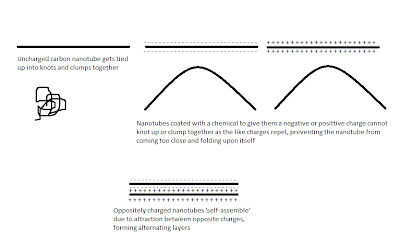 This ensured that the nano-scale porosity of the carbon nanotubes was maintained, making a large number of oxygen atoms accessible to incoming cations. Along with the very high conductivity of carbon nanotubes, the cathode could accept a large number of cations and move them very quickly, generating a large amount of power and retaining the energy capacity of a battery. The newly fangled contraption gives energy output 5 times that of a capacitor at a power delivery rate 10 times that of a lithium ion battery.
Several problems remain though, for rapid commercialisation. For example: The researchers created the electrode manually, with a 3 micrometer thick electrode consuming 8000 minutes to make. Scaling up of the technology in a rapid yet cost-effective manner is necessary and is underway. If this should work out the days of iPhones and Droids going the distance after a single juice up are not far off, nor are, for that matter, electric vehicles powered by powerful batteries.
Life today is electronic; connected; made possible by devices which bring information at our fingertips (or rather mobile screens) when and where we want them. For all the power and promise of these miraculous- and now ubiquitous devices, their effectiveness is stymied by the most basic (and oldest) of problems.
Energy!
Modern devices have to maintain their lilliputian size to please the modern consumer and for practicality of mobility, but this comes at the price of smaller and lower capacity battery. Lithium polymer batteries are the latest in battery tech, but they also collide against their limitations when faced with the onslaught of the power hungry and demanding nature of today's consumers. These batteries have high energy densities, capable of providing energy slowly, for hours at end, but they also take a long time to charge and have less power. Capacitors are small devices which can hold electrical charge. They charge up quickly and deliver that in a single powerful burst at a precise moment. Camera flash is the easiest example which comes to mind.
Batteries have a positively charged anode, electrically linked to a negatively charged cathode via a conducting solution called an electrolyte. Positively charged ions move from anode to cathode, generating a current to power our devices, while recharging moves these ions back to anode. An ideal battery would be something which would combine the rapid charging and high power output of a capacitor with the energy density of a battery.
A research group in MIT may have answered our digital prayers, they managed to upgrade the cathode to a whole new level using carbon nanotubes- single molecule thick tubes of carbon- coated with a chemical which gave them a negative or a positive charge. The researchers dipped a base substrate material alternately into a positive and negatively charged carbon nanotube solutions. The oppositely charged layers allowed the nanotubes to successfully self-assemble into monolayers rather then getting clumped together (link to article).
 This ensured that the nano-scale porosity of the carbon nanotubes was maintained, making a large number of oxygen atoms accessible to incoming cations. Along with the very high conductivity of carbon nanotubes, the cathode could accept a large number of cations and move them very quickly, generating a large amount of power and retaining the energy capacity of a battery. The newly fangled contraption gives energy output 5 times that of a capacitor at a power delivery rate 10 times that of a lithium ion battery.
Several problems remain though, for rapid commercialisation. For example: The researchers created the electrode manually, with a 3 micrometer thick electrode consuming 8000 minutes to make. Scaling up of the technology in a rapid yet cost-effective manner is necessary and is underway. If this should work out the days of iPhones and Droids going the distance after a single juice up are not far off, nor are, for that matter, electric vehicles powered by powerful batteries.
June 10, 2010
On the Wings of a Butterfly
The wings of a butterfly attract our attention for their marvellous colours. Have you noticed how the colour in some butterfly wings change depending on observer's position? These colours and their changing behaviour is because of well defined patterns on the wings. These patterns are visible when observed through nano-scale viewing microscopes (Scanning Electron Microscopes or Atomic Force Microscopy etc.). The physics behind these colours is now well understood, a combination of reflection, refraction and diffraction. Unlike reflection and refraction, it is the principle of diffraction which depends on the size of different shapes on the wings.

Recently, researchers in Cambridge Nano-science Centre have not just replicated these butterfly wings at the nanoscale but have shown capacity to tune their behaviour by selectively altering the nanoscale shapes. They have done this by the bottom-up approach (link), making small objects and thin films one-at-a-time.
This approach followed by researchers helps to create even more beautiful colours (see image below, click to enlarge) and aids in confirming the earlier proposed mechanisms which produce the concoction of colours on the wings of a butterfly (link to article).

Reprinted by permission from Macmillan Publishers Ltd: Nature Nanotechnology (PUBLISHED ONLINE: 30 MAY 2010 | DOI: 10.1038/NNANO.2010.101), copyright 2010.
June 9, 2010
Open Innovation in Nanotechnology
One of the most significant new evolving development concepts in industry is Open-Innovation. Companies facing an issue pose a question for the whole wide world like a challenge. It is a leap in corporate culture where it is now realized that the best way to solve a problem is by sharing it.
The firms do not risk too much but can benefit a lot since:
(a) If someone has a solution then it would be virtually impossible for an individual or a small player to overtake the giant corporation and thus would not pose a threat,
(b) Moreover no one would give the 'solution finder' a better quick reward than the solution seeker themselves.
It is here that most academic research /inventors/free lancers etc. and industry are crossing paths. Open innovation inventor Henry Chesbrough's blog.
Nanotechnology can benefit significantly from open innovation-
Nanotechnology can be divided into bottom-up or top-down approaches. The top-down approach is where existing products are miniaturized. This is often reflected in the rapidly evolving electronic market which are catered-to by foundries in Taiwan and S.Korea. These foundries make small transistors for electronic chips.
But from the open-innovation pov, bottom-up approach is where most of todays research is focussed since it has shown enormous potential to improve every sphere of life - medicine, textiles, cosmetics, chemicals etc. even steel is being made stronger (http://www.outokumpu.com/).
One of the key challenges is the multidisciplinary nature of nanotechnology and nano-related sciences (Shea 2005; Palmberg and Nikulainen 2006 link). Nanotechnology and nanosciences draw upon a variety of different disciplines. It is related to both organic and inorganic disciplines, such as physics, chemistry, biology and biosciences. Thus, for large incumbents to benefit from the technological and scientific advances in nanotechnology it might be best to share the problems or collaborate with research organizations. Thus by spreading the awareness of the problem among relevant knowledge groups the companies stand the best chance to find a solution and gain an edge over their competitor.
Here is a sample list of selected open innovation initiatives relevant to the nano-sphere and otherwise
1. Identification of new materials that mimic human skin (link)
2. Solutions to the response to the 'OIL SPILL IN THE GULF OF MEXICO' (link)
3. Submit your innovation to P&G (link)
4. Nokia's collaborative open innovation world map (link)
The firms do not risk too much but can benefit a lot since:
(a) If someone has a solution then it would be virtually impossible for an individual or a small player to overtake the giant corporation and thus would not pose a threat,
(b) Moreover no one would give the 'solution finder' a better quick reward than the solution seeker themselves.
It is here that most academic research /inventors/free lancers etc. and industry are crossing paths. Open innovation inventor Henry Chesbrough's blog.
Nanotechnology can benefit significantly from open innovation-
Nanotechnology can be divided into bottom-up or top-down approaches. The top-down approach is where existing products are miniaturized. This is often reflected in the rapidly evolving electronic market which are catered-to by foundries in Taiwan and S.Korea. These foundries make small transistors for electronic chips.
But from the open-innovation pov, bottom-up approach is where most of todays research is focussed since it has shown enormous potential to improve every sphere of life - medicine, textiles, cosmetics, chemicals etc. even steel is being made stronger (http://www.outokumpu.com/).
One of the key challenges is the multidisciplinary nature of nanotechnology and nano-related sciences (Shea 2005; Palmberg and Nikulainen 2006 link). Nanotechnology and nanosciences draw upon a variety of different disciplines. It is related to both organic and inorganic disciplines, such as physics, chemistry, biology and biosciences. Thus, for large incumbents to benefit from the technological and scientific advances in nanotechnology it might be best to share the problems or collaborate with research organizations. Thus by spreading the awareness of the problem among relevant knowledge groups the companies stand the best chance to find a solution and gain an edge over their competitor.
Here is a sample list of selected open innovation initiatives relevant to the nano-sphere and otherwise
1. Identification of new materials that mimic human skin (link)
2. Solutions to the response to the 'OIL SPILL IN THE GULF OF MEXICO' (link)
3. Submit your innovation to P&G (link)
4. Nokia's collaborative open innovation world map (link)
June 8, 2010
Apple's Iphone 4 - Whats nano about that ?
Apple unveiled the new iphone 4 yesterday in San Francisco, their design homeland from where originate their license to publish 'Designed in California' on all products.
It is an amazing product with many new features well visible here (this would need quicktime installed). With this product Apple aims to re-conquer lost ground after Google's android and other smartphones capitalized market and application developer's inclination.
At the heart of the great many features is the new A4 processor manufactured by Samsung. Wherein lies nanotechnology..this new processor is made of transistors (the basic binary computing unit used in electronics today) with features as small as 45 nanometers (nm), roughly a thousand times smaller than the thickness of human hair. For an amazing analysis of the chip see details here.
Simply put:
Smaller the transistors, larger their number on a chip. Thus, either the device can be smaller or if the chip is still the same size then faster or both. Earlier versions were made by the 65nm technology.
For the new iphone 4 Apple has chosen both increased speed and reduced size and Samsung has delivered.
This new A4 processor can clock 1GHz speed which allows the software gurus to harness this capacity by multi-threading, piping; otherwise, efficient coding etc. amply visible in the use of any Apple Operating System.
Great advance in nanotechnology by Samsung coupled with novel Apple OS has produced the new marvel - Iphone 4.
It is an amazing product with many new features well visible here (this would need quicktime installed). With this product Apple aims to re-conquer lost ground after Google's android and other smartphones capitalized market and application developer's inclination.
At the heart of the great many features is the new A4 processor manufactured by Samsung. Wherein lies nanotechnology..this new processor is made of transistors (the basic binary computing unit used in electronics today) with features as small as 45 nanometers (nm), roughly a thousand times smaller than the thickness of human hair. For an amazing analysis of the chip see details here.
Simply put:
Smaller the transistors, larger their number on a chip. Thus, either the device can be smaller or if the chip is still the same size then faster or both. Earlier versions were made by the 65nm technology.
For the new iphone 4 Apple has chosen both increased speed and reduced size and Samsung has delivered.
This new A4 processor can clock 1GHz speed which allows the software gurus to harness this capacity by multi-threading, piping; otherwise, efficient coding etc. amply visible in the use of any Apple Operating System.
Great advance in nanotechnology by Samsung coupled with novel Apple OS has produced the new marvel - Iphone 4.
Subscribe to:
Posts (Atom)