Nanotechnlogy business is of great significance today. Nanoscale science and technology enhanced/developed products promise to benefit all domains of consumables- foods, beverages and medicine, to, cosmetics, textiles and ornamental jewelry. Sensors on-board automobiles, cars and spaceships, to, green-energy, electronics and IT. There must be an exceptional domain which stands not to gain from the advantages of understanding and engineering of the nanoscale (literally bottom up).
However, a discipline with so much potential for advancement has remained limited to a very few industries. It is of no doubt that nanotechnology can be useful but what is of doubt is that in our business driven society does nanotechnology have a generic business model?
Most of the nanotechnology based products are manufactured in clean rooms. The infrastructure required to build a clean room [a controlled environment where pressure, temperature, humidity and most importantly cleanliness is strictly controlled] is so expensive that a handful of countries outside the developed world possess it for research. Likewise for businesses, lack of easy-to-implement nanotechnological features cost-effectively in products make the whole exercise a 'no-go' before a feasibility report is outlined.
If most countries do not have the research infrastructure (local knowledge base) and the industry finds it too expensive- obviously nanotechnology for all its promise may remain in-hatching unless a disruptive technology shakes us. Social impact of a high-entry-barrier in nanotechnology can be more detrimental - whenever nanotech takes off it shall only be the developed world making profit since the research itself was so difficult to undertake elsewhere, creating a wider divide amongst poor and rich countries.
Summarizing above, it all boils down to cost of nanotechnology.
One model which has succeeded in resolving the questions above is the multi-project center (MPC) model. A large facility, either government funded or in a public-private partnership model can set up the infrastructure (clean rooms and such) to be shared by the local universities and regional industry. IMEC in Belgium and LETI in France are great examples. While universities supply manpower for research into unexplored territories companies fund research projects to find the best solutions for their businesses and patent them. The manpower on the floor is skilled and employed by the MPC.
A MPC can be national/regional infrastructure fostering the growth of nanotech solutions for the advancement of society just as highways developed the automobile industry. [A more fitting analogy may perhaps be electricity to every household but today when 4/5 (Hans Rosling's statistics) of the world lacks basic health care and services, such an analogy though appropriate, is sadly ahead of its time.]
A model such as a regional MPC, would not only ensure industries flourish but also create wealth of knowledge locally, while stepping forward towards the technology of the future. If this seems an experimental idea then note that on this model some parts of the world are producing most of the high-technology products in the market.
Showing posts with label Energy. Show all posts
Showing posts with label Energy. Show all posts
July 17, 2011


August 24, 2010
Energy Harvesting
Recently we have published a series of posts on clean energy, green power and bio-fuel cells, these alternatives are essential to diminish our over-arching dependence on fossil fuel and to move further towards greener options. In the same vein a generic subject, energy harvesting promises to explore even more avenues for producing low power.
Q. What is 'Energy Harvesting'?
Q. What is 'Energy Harvesting'?
A. Energy harvesting is a term associated with capture and storage of energy for small power requirements. It is frequently used for power capacity in milliwatt, microwatt, nanowatt to picowatt power range. For a gauge of scale of power-producers, solar panels are easily able to produce tens of watts of power on a sunny day. A typical device like a light bulb consumes 60W of power.
Q. Then why do we need small power 'Energy Harvesting'?
A. There are lots of markets. For example, present day medical problems like diabetes, pacemakers, and other implantable biomedical devices can benefit from such small 'Energy Harvesting Devices'. Another example is live-patient monitoring chips. These chips with sensors implanted within the body can provide the medical examiner with live heartbeats, pulses, sugar, blood pressure, even fats and cholestrol, haemoglobin levels, remotely, i.e. the patient need not be in the clinic.
Another potential markets is electronics. The capacity to produce extremely small electronics also opens the door to extremely low power electronics. Although so far the benefit of scaling (reducing the size of transistor) has led to more computation-efficient and capable hardware, the power scaling with size scaling is yet to see its full potential. Lot of wireless technologies are focussing on this aspect (see here).
An interesting example is the Contact lens LED projector and sensor (here).
Q. What are the typical 'Energy Harvesting Devices'?
A. We dont call Solar panels as energy harvesters in the conventional sense, although literally they are. However, more interesting concepts involve use of microwave, radio wave and other electromagnetic energy that surrounds us all the time in the modern world because of cell-phone towers, TV towers, radio waves etc.
Another dimension of energy harvesting is through human being themselves. We daily produce a large amount of energy to enable us to do many tasks. However, there is potential to harvest part of this energy by transduction (conversion of energy).
Consider a person wearing a body suit which has flexible solar panels and at every human body joint there is a piezo. Thus while walking in the sun one could be harvesting solar energy, and motion of the limbs producing extra energy through the piezo. But this is just the tip, there is lot of effort dedicated to harnessing the chemical energy from within our bodies (see our post here) and thermal energy our body generates throughout the day.
Q. Is Energy Harvesting green?
A. Yes, and thats the whole point. To harvest energy from what is around us and within us. It embodies the concept of traditional rural farming (hence the term harvesting) by using available resources (electromagnetic waves, solar energy, body heat, internal chemicals within the body, small mechanical motions) and by energetically favourable simple transduction (conversion) process yield a produce (power).
The research community has already demonstrated tools like solar panels, piezos, low power sensors, GBFC's (glucose bio-fueld cells), most of which are highly commercial. So its a matter of time.
The research community has already demonstrated tools like solar panels, piezos, low power sensors, GBFC's (glucose bio-fueld cells), most of which are highly commercial. So its a matter of time.
Q. What are the challenges for 'Energy harvesting'?
A. The biggest challenge is low power devices, the entire electronic and technical industry is focussed on highly complex and more processing capacity whereas, the most useful products to humanity require low power, small size, moderate computation-ability. Consistent effort is needed in this direction.
Another critical thing is that the lifetime of energy harvesting products. If energy harvesting products are to become BIG then they must provide the advantage of longer life of products even if they have low power capacity. Further, a critical requirement is small size rechargeable batteries so that the power produced may be stored. And there is a lot of room for system level innovation at this stage.
August 9, 2010
Bio-Fuel Cells, Batteries not required
"So, how long do you live? I mean, last?"
"My fuel cell lasts for 120 years."
While killer cyborgs with long-lasting fuel cells is uber cool (unless you are the one they are after), one doesn't require a Terminator to be a cyborg or claim long-lasting fuel cells.
Most of us are anyway part human part machine using spectacles, hearing aids, cochlear implants, pacemakers, deep-brain stimulation devices, urinary sphincters, insulin pumps and so on. Apart from making us cybernetic organisms (cyborgs in vernacular) it also adds to us something in common with the terminators.
Batteries.
All these devices require power to work. Power provided by cells which are usually implanted within the body. The best of these run out of juice in 5-8 years, after which one must undergo a surgery to replace them or wait around while you plug yourself in to recharge with wires penetrating the skin and connected to an external battery.
While its an acceptable alternative to death, all masochism aside, it is inconvenient.
They are also something of a dweeb as to the amount of power they can provide, so that power-hungry, artificial, implantable kidneys and hearts are still in the dark.
A team of scientists seem hell-bent on correcting this disparity between humans and terminators. But rather than simply use batteries, which must be charged up, they have invented fuel cells which generate their own power, like a mini generator.
Cells which run off the glucose found naturally in the blood!
The Glucose bio-fuel cell or GBFC has graphite discs for electrodes, wrapped in semipermeable-biocompatible plastic used in dialysis machines. The plastic packs the enzymes- Glucose Oxidase (GOX), Catalase and Urease, Ubiquinone at anode and Quinhydrone at cathode. The semi-permeable plastic allows glucose molecules to seep in while keeping most other things out. GOX strips electrons from glucose molecules locally and reduces the pH while Urease increases the pH, the difference driving electron exchange. These electron displacement occurs to and from the electrodes via electron-shuttles Ubiquinone and Quinhydrone, respectively. This leads to electric current. Catalase breaks down the toxic hydrogen peroxide generated as a consequence of GOX activity also providing additional oxygen for GOX to work with.
The breakthrough can be attributed to a change of approach, where instead of chemically attaching the enzymes with the electrodes (which the enzymes don't like) they are just tightly packed within a plastic sheath. The enzymes used are immune to interference from the ions in the body and can work stably at physiological pH. Earlier ones used needed acidic conditions.
The electrodes take up around 0.266 mL in a merely 5 mL cell. The present device can generate around 24.4 µW per mL of peak power and a stable power of 7.52 µW/mL, while a typical pacemaker requires 10 µW.
The scientists claim they have made a 50 fold improvement in the power characteristics of the cell since the paper was published.
While this fuel cell has shown a great improvement in peak power output and actively integrates the device with glucose from the body, the reliability and lifetime of such a new technology still needs various medical certifications/approvals before we benefit from a revolution in biomedical technology.
"So, how long do you live? I mean, last?"
July 9, 2010
Carbon Nanotube enhanced Li-Ion Batteries
Energiser bunny arrested, charged with battery....well sort of
Life today is electronic; connected; made possible by devices which bring information at our fingertips (or rather mobile screens) when and where we want them. For all the power and promise of these miraculous- and now ubiquitous devices, their effectiveness is stymied by the most basic (and oldest) of problems.
Energy!
Modern devices have to maintain their lilliputian size to please the modern consumer and for practicality of mobility, but this comes at the price of smaller and lower capacity battery. Lithium polymer batteries are the latest in battery tech, but they also collide against their limitations when faced with the onslaught of the power hungry and demanding nature of today's consumers. These batteries have high energy densities, capable of providing energy slowly, for hours at end, but they also take a long time to charge and have less power. Capacitors are small devices which can hold electrical charge. They charge up quickly and deliver that in a single powerful burst at a precise moment. Camera flash is the easiest example which comes to mind.
Batteries have a positively charged anode, electrically linked to a negatively charged cathode via a conducting solution called an electrolyte. Positively charged ions move from anode to cathode, generating a current to power our devices, while recharging moves these ions back to anode. An ideal battery would be something which would combine the rapid charging and high power output of a capacitor with the energy density of a battery.
A research group in MIT may have answered our digital prayers, they managed to upgrade the cathode to a whole new level using carbon nanotubes- single molecule thick tubes of carbon- coated with a chemical which gave them a negative or a positive charge. The researchers dipped a base substrate material alternately into a positive and negatively charged carbon nanotube solutions. The oppositely charged layers allowed the nanotubes to successfully self-assemble into monolayers rather then getting clumped together (link to article).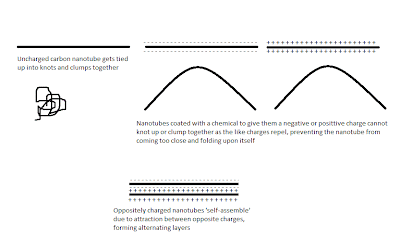 This ensured that the nano-scale porosity of the carbon nanotubes was maintained, making a large number of oxygen atoms accessible to incoming cations. Along with the very high conductivity of carbon nanotubes, the cathode could accept a large number of cations and move them very quickly, generating a large amount of power and retaining the energy capacity of a battery. The newly fangled contraption gives energy output 5 times that of a capacitor at a power delivery rate 10 times that of a lithium ion battery.
Several problems remain though, for rapid commercialisation. For example: The researchers created the electrode manually, with a 3 micrometer thick electrode consuming 8000 minutes to make. Scaling up of the technology in a rapid yet cost-effective manner is necessary and is underway. If this should work out the days of iPhones and Droids going the distance after a single juice up are not far off, nor are, for that matter, electric vehicles powered by powerful batteries.
Life today is electronic; connected; made possible by devices which bring information at our fingertips (or rather mobile screens) when and where we want them. For all the power and promise of these miraculous- and now ubiquitous devices, their effectiveness is stymied by the most basic (and oldest) of problems.
Energy!
Modern devices have to maintain their lilliputian size to please the modern consumer and for practicality of mobility, but this comes at the price of smaller and lower capacity battery. Lithium polymer batteries are the latest in battery tech, but they also collide against their limitations when faced with the onslaught of the power hungry and demanding nature of today's consumers. These batteries have high energy densities, capable of providing energy slowly, for hours at end, but they also take a long time to charge and have less power. Capacitors are small devices which can hold electrical charge. They charge up quickly and deliver that in a single powerful burst at a precise moment. Camera flash is the easiest example which comes to mind.
Batteries have a positively charged anode, electrically linked to a negatively charged cathode via a conducting solution called an electrolyte. Positively charged ions move from anode to cathode, generating a current to power our devices, while recharging moves these ions back to anode. An ideal battery would be something which would combine the rapid charging and high power output of a capacitor with the energy density of a battery.
A research group in MIT may have answered our digital prayers, they managed to upgrade the cathode to a whole new level using carbon nanotubes- single molecule thick tubes of carbon- coated with a chemical which gave them a negative or a positive charge. The researchers dipped a base substrate material alternately into a positive and negatively charged carbon nanotube solutions. The oppositely charged layers allowed the nanotubes to successfully self-assemble into monolayers rather then getting clumped together (link to article).
 This ensured that the nano-scale porosity of the carbon nanotubes was maintained, making a large number of oxygen atoms accessible to incoming cations. Along with the very high conductivity of carbon nanotubes, the cathode could accept a large number of cations and move them very quickly, generating a large amount of power and retaining the energy capacity of a battery. The newly fangled contraption gives energy output 5 times that of a capacitor at a power delivery rate 10 times that of a lithium ion battery.
Several problems remain though, for rapid commercialisation. For example: The researchers created the electrode manually, with a 3 micrometer thick electrode consuming 8000 minutes to make. Scaling up of the technology in a rapid yet cost-effective manner is necessary and is underway. If this should work out the days of iPhones and Droids going the distance after a single juice up are not far off, nor are, for that matter, electric vehicles powered by powerful batteries.
Subscribe to:
Posts (Atom)