Nanotechnlogy business is of great significance today. Nanoscale science and technology enhanced/developed products promise to benefit all domains of consumables- foods, beverages and medicine, to, cosmetics, textiles and ornamental jewelry. Sensors on-board automobiles, cars and spaceships, to, green-energy, electronics and IT. There must be an exceptional domain which stands not to gain from the advantages of understanding and engineering of the nanoscale (literally bottom up).
However, a discipline with so much potential for advancement has remained limited to a very few industries. It is of no doubt that nanotechnology can be useful but what is of doubt is that in our business driven society does nanotechnology have a generic business model?
Most of the nanotechnology based products are manufactured in clean rooms. The infrastructure required to build a clean room [a controlled environment where pressure, temperature, humidity and most importantly cleanliness is strictly controlled] is so expensive that a handful of countries outside the developed world possess it for research. Likewise for businesses, lack of easy-to-implement nanotechnological features cost-effectively in products make the whole exercise a 'no-go' before a feasibility report is outlined.
If most countries do not have the research infrastructure (local knowledge base) and the industry finds it too expensive- obviously nanotechnology for all its promise may remain in-hatching unless a disruptive technology shakes us. Social impact of a high-entry-barrier in nanotechnology can be more detrimental - whenever nanotech takes off it shall only be the developed world making profit since the research itself was so difficult to undertake elsewhere, creating a wider divide amongst poor and rich countries.
Summarizing above, it all boils down to cost of nanotechnology.
One model which has succeeded in resolving the questions above is the multi-project center (MPC) model. A large facility, either government funded or in a public-private partnership model can set up the infrastructure (clean rooms and such) to be shared by the local universities and regional industry. IMEC in Belgium and LETI in France are great examples. While universities supply manpower for research into unexplored territories companies fund research projects to find the best solutions for their businesses and patent them. The manpower on the floor is skilled and employed by the MPC.
A MPC can be national/regional infrastructure fostering the growth of nanotech solutions for the advancement of society just as highways developed the automobile industry. [A more fitting analogy may perhaps be electricity to every household but today when 4/5 (Hans Rosling's statistics) of the world lacks basic health care and services, such an analogy though appropriate, is sadly ahead of its time.]
A model such as a regional MPC, would not only ensure industries flourish but also create wealth of knowledge locally, while stepping forward towards the technology of the future. If this seems an experimental idea then note that on this model some parts of the world are producing most of the high-technology products in the market.
Showing posts with label Chemistry. Show all posts
Showing posts with label Chemistry. Show all posts
July 17, 2011


July 9, 2010
Carbon Nanotube enhanced Li-Ion Batteries
Energiser bunny arrested, charged with battery....well sort of
Life today is electronic; connected; made possible by devices which bring information at our fingertips (or rather mobile screens) when and where we want them. For all the power and promise of these miraculous- and now ubiquitous devices, their effectiveness is stymied by the most basic (and oldest) of problems.
Energy!
Modern devices have to maintain their lilliputian size to please the modern consumer and for practicality of mobility, but this comes at the price of smaller and lower capacity battery. Lithium polymer batteries are the latest in battery tech, but they also collide against their limitations when faced with the onslaught of the power hungry and demanding nature of today's consumers. These batteries have high energy densities, capable of providing energy slowly, for hours at end, but they also take a long time to charge and have less power. Capacitors are small devices which can hold electrical charge. They charge up quickly and deliver that in a single powerful burst at a precise moment. Camera flash is the easiest example which comes to mind.
Batteries have a positively charged anode, electrically linked to a negatively charged cathode via a conducting solution called an electrolyte. Positively charged ions move from anode to cathode, generating a current to power our devices, while recharging moves these ions back to anode. An ideal battery would be something which would combine the rapid charging and high power output of a capacitor with the energy density of a battery.
A research group in MIT may have answered our digital prayers, they managed to upgrade the cathode to a whole new level using carbon nanotubes- single molecule thick tubes of carbon- coated with a chemical which gave them a negative or a positive charge. The researchers dipped a base substrate material alternately into a positive and negatively charged carbon nanotube solutions. The oppositely charged layers allowed the nanotubes to successfully self-assemble into monolayers rather then getting clumped together (link to article).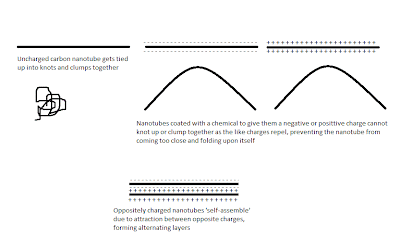 This ensured that the nano-scale porosity of the carbon nanotubes was maintained, making a large number of oxygen atoms accessible to incoming cations. Along with the very high conductivity of carbon nanotubes, the cathode could accept a large number of cations and move them very quickly, generating a large amount of power and retaining the energy capacity of a battery. The newly fangled contraption gives energy output 5 times that of a capacitor at a power delivery rate 10 times that of a lithium ion battery.
Several problems remain though, for rapid commercialisation. For example: The researchers created the electrode manually, with a 3 micrometer thick electrode consuming 8000 minutes to make. Scaling up of the technology in a rapid yet cost-effective manner is necessary and is underway. If this should work out the days of iPhones and Droids going the distance after a single juice up are not far off, nor are, for that matter, electric vehicles powered by powerful batteries.
Life today is electronic; connected; made possible by devices which bring information at our fingertips (or rather mobile screens) when and where we want them. For all the power and promise of these miraculous- and now ubiquitous devices, their effectiveness is stymied by the most basic (and oldest) of problems.
Energy!
Modern devices have to maintain their lilliputian size to please the modern consumer and for practicality of mobility, but this comes at the price of smaller and lower capacity battery. Lithium polymer batteries are the latest in battery tech, but they also collide against their limitations when faced with the onslaught of the power hungry and demanding nature of today's consumers. These batteries have high energy densities, capable of providing energy slowly, for hours at end, but they also take a long time to charge and have less power. Capacitors are small devices which can hold electrical charge. They charge up quickly and deliver that in a single powerful burst at a precise moment. Camera flash is the easiest example which comes to mind.
Batteries have a positively charged anode, electrically linked to a negatively charged cathode via a conducting solution called an electrolyte. Positively charged ions move from anode to cathode, generating a current to power our devices, while recharging moves these ions back to anode. An ideal battery would be something which would combine the rapid charging and high power output of a capacitor with the energy density of a battery.
A research group in MIT may have answered our digital prayers, they managed to upgrade the cathode to a whole new level using carbon nanotubes- single molecule thick tubes of carbon- coated with a chemical which gave them a negative or a positive charge. The researchers dipped a base substrate material alternately into a positive and negatively charged carbon nanotube solutions. The oppositely charged layers allowed the nanotubes to successfully self-assemble into monolayers rather then getting clumped together (link to article).
 This ensured that the nano-scale porosity of the carbon nanotubes was maintained, making a large number of oxygen atoms accessible to incoming cations. Along with the very high conductivity of carbon nanotubes, the cathode could accept a large number of cations and move them very quickly, generating a large amount of power and retaining the energy capacity of a battery. The newly fangled contraption gives energy output 5 times that of a capacitor at a power delivery rate 10 times that of a lithium ion battery.
Several problems remain though, for rapid commercialisation. For example: The researchers created the electrode manually, with a 3 micrometer thick electrode consuming 8000 minutes to make. Scaling up of the technology in a rapid yet cost-effective manner is necessary and is underway. If this should work out the days of iPhones and Droids going the distance after a single juice up are not far off, nor are, for that matter, electric vehicles powered by powerful batteries.
Subscribe to:
Posts (Atom)